
How can a 100-page specification become a clearly defined testing scope?
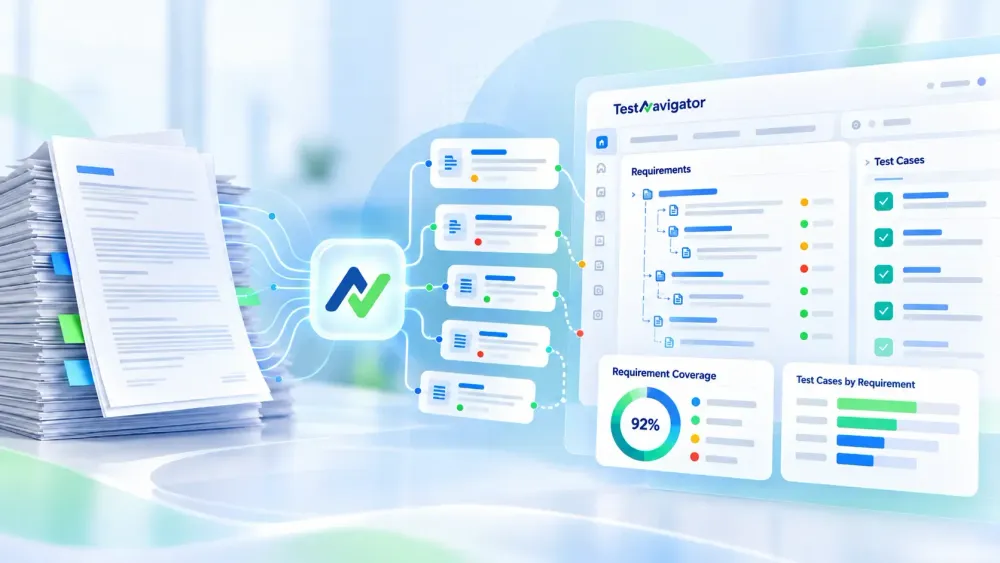
Turning lengthy software specifications into a structured testing scope has traditionally required significant manual effort. AI-powered QA and test management platforms are transforming this process by extracting requirements, supporting test case generation, and identifying gaps in requirement coverage. With AI assistants, testing teams can also access and interpret project information using natural language. These capabilities reduce repetitive work and allow QA professionals to focus on risk assessment, test quality, and release readiness.
For a long time, one of the most time-consuming aspects of software testing was not executing tests, but determining exactly what needed to be tested. When working with lengthy specifications, testers had to review documentation page by page, identify requirements, define test scenarios, and manually create test cases based on their findings. Processing a hundred-page specification could easily turn into several days of repetitive administrative work.
Advances in AI are fundamentally changing this process. Today, AI-powered QA and test management platforms can help interpret documentation, identify requirements relevant to testing, and support the verification of those requirements.
From manual test case creation to AI-powered test planning
Traditionally, a new specification involved numerous manual steps. Testers reviewed the document, identified functional expectations, business rules, and edge cases, and then designed the necessary tests for each relevant requirement. Whenever the specification changed, they had to revisit the documentation to determine which requirements had been modified and which test cases needed updating.
This process was not only time-consuming but also highly repetitive. Furthermore, the larger the documentation, the harder it became to ensure that every requirement was adequately covered by test cases.
This is where generative AI can significantly reduce the workload involved in QA management. A 2026 literature review examined 21 previous studies exploring how AI, natural language processing (NLP), and large language models can be used to generate test cases from requirements written in natural language. The review found that this field is developing rapidly, although traceability and human oversight remain essential parts of the process.
Turning documentation into a source of testing data
TestNavigator's new AI capabilities take this process a step further. Once a specification is uploaded, AI identifies and extracts the requirements contained in the document, organizing them into a structured format. Test cases can then be generated from these requirements, eliminating the need for testers to create every test case from scratch.
However, the real benefit goes beyond test case generation. AI can also analyze whether each requirement is already associated with an appropriate test case. This provides visibility not only into which test cases have been created, but also into which requirements are adequately covered and where testing gaps remain.
This represents a fundamental shift in how testing scope is evaluated. Rather than assessing its completeness solely by reviewing existing test cases, the process starts with the requirements and examines whether suitable test cases exist for each one.
As a result, requirement coverage becomes more transparent, making it easier to identify which requirements are addressed by existing tests and which areas still need attention.
An AI assistant can also help teams understand their projects
In larger projects, simply finding the right information can be time-consuming. Which requirements apply to a particular feature? Which requirements do not yet have test cases? Which tests are associated with a specific business process?
With an AI assistant connected to a project and its testing documentation, users can ask these questions in natural language.
Instead of searching through documents, test suites, and different views, users can interact directly with the AI assistant, which retrieves and summarizes relevant information based on the project data they are authorized to access.
This means that information stored in the test management platform is no longer accessible only through traditional interfaces and reports. With AI, users can also query and interpret project data using natural language.
Speed is becoming increasingly important in AI-powered QA
AI is making certain workflows easier and faster across almost every knowledge-based profession, and software development and QA are no exceptions.
According to DORA research, 90% of technology professionals already use AI in their work, while more than 80% report that it has improved their productivity. However, DORA also emphasizes that AI primarily serves as an enabling technology: it makes well-established processes more efficient, but appropriate control and verification mechanisms remain necessary.
This is particularly relevant for QA. Another survey conducted in 2026 among 273 software development and QA decision-makers found that 93% of respondents had already used AI-powered coding tools, while 92% still performed manual testing. At the same time, 68% were concerned that AI-accelerated development would create testing bottlenecks.
Less manual work, more time for critical QA decisions
As development accelerates, QA teams may struggle to keep pace if requirements analysis, test planning, and coverage verification remain largely manual.
The purpose of AI is not to replace the professional judgment of testers. Instead, it is to take over time-consuming, repetitive tasks that previously required hours or even days of work.
This allows testers to dedicate more time to assessing risks, addressing complex testing scenarios, and making informed decisions that directly affect release quality and readiness.